Showing posts with label CCCADI. Show all posts

Friday, October 22, 2021

Back in Puerto Rico, Martorell's Exhibit Grounds Me


Last week I had the opportunity to take a short trip to Puerto Rico with my friend, Marie. It was the first time I had been to the island since my trip with Caribbean Cultural Center African Diaspora Institute (CCCADI) to participate in the Community Arts University Without Walls (CAUWW) program in 2015. That's when I started this blog, Travesia Artistica, initially to document my amazing experiences in the two-week program that took us from the campus is InterAmerican University, to arts and cultural sites all over Puerto Rico. Now as the blog lives on six years later, it is only fitting that I write about my brief return to the island I love so much. 

CAUWW was a totally unique program which is no longer offered, so I was extremely lucky to have participated when I did, lead by the indomitable Dr.  Marta Moreno Vega, who has since retired. One of the incredible things my cohort experienced was a day trip to Ponce, in which we managed to do many things, including taking a private tour of renowned Puerto Rican artist Antonio Martorell's studio. It was a pleasure to meet him and have the opportunity to experience the work of a prolific multidisciplinary artist first hand. 

Coincidentally, upon my 2021 visit to Puerto Rico, I noticed that Museo de las Américas was about to open a new show: Entretelas - Antonio Martorell y sus amigos. In fact, Marie and I were able to go on opening day! I thought this was the perfect thing to post about here, as a full-circle moment, especially because so many events have taken place worldwide and particularly in Puerto Rico since the last time I was there. Martorell's work touches on it all, poetically.

While lovely to behold, Martorell's masterful body of work in Entretelas... reaches for a "state of grace" and recovery after four years of  tragedies caused by "misgovernment, seasonal hurricanes on the Atlantic... the multiplication and mutation of the pandemic virus, the tremors and the earthquakes [which have forced] changes in Puerto Rican daily life." 

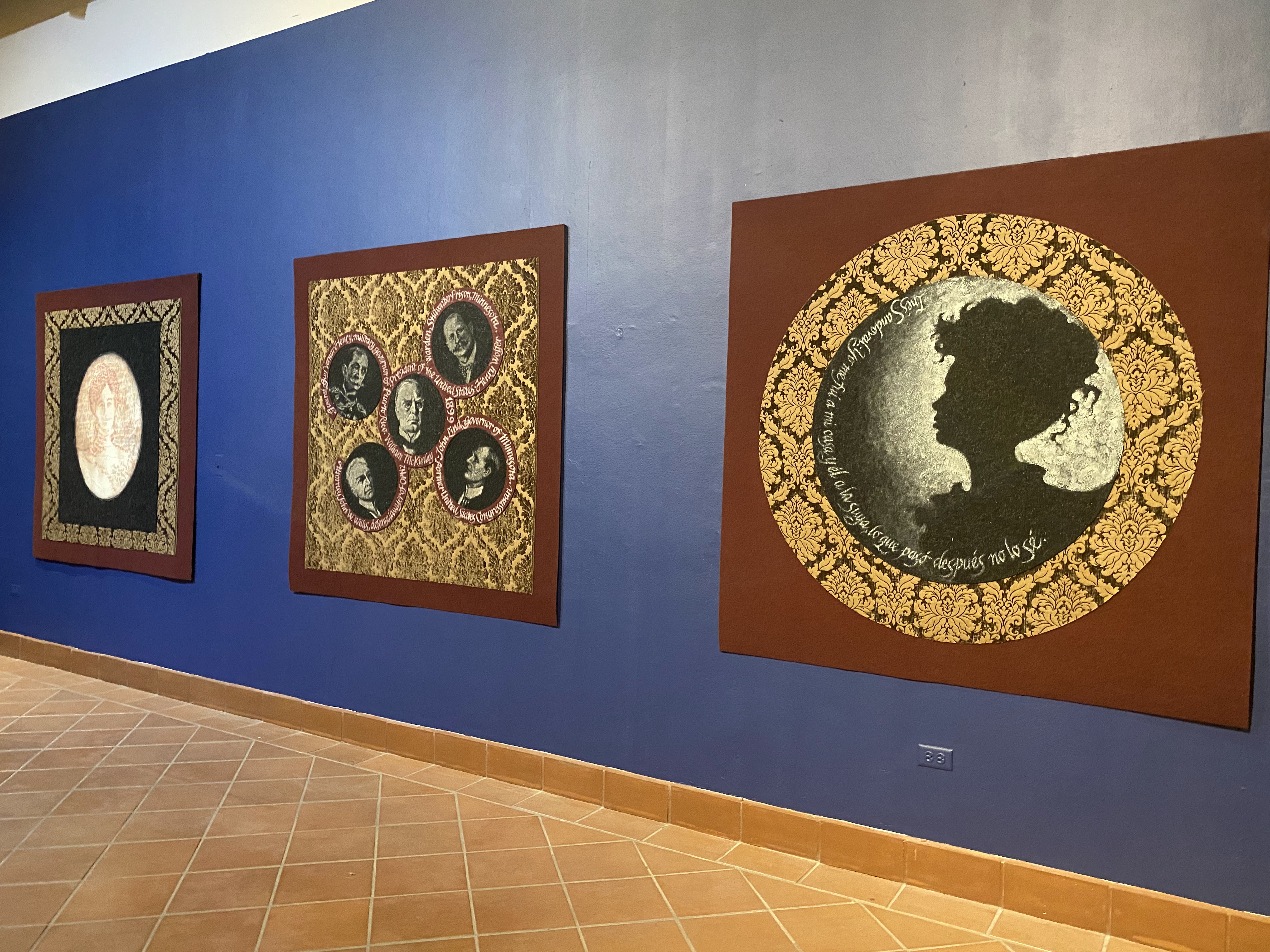
The exhibit, starting with portraits painted onto heavy tapestries explores subject matter from family portraits, to those of historical figures, and those who were wrongfully reincarcerated throughout history. Although there are many paintings in the first salon, in typical Martorell style. he takes a left in the second salon presenting a variety of styles and materials, from colorful fibers to wood and even found fallen tree branches from Hurricane Maria's fallout, reminding us of the devastation experienced, and the friends and family members who have been lost.

I was lucky to be able to see Entretelas... first hand and even take some photos which I share with you here. 

Courtyard inside of Museo de las Americas 

On the second floor, facing into the courtyard

Didactic wall panel for Enretelas...

First room of the exhibition. Portraits painted on upholstery fabrics 


Self-portrait of Martorell 

The Mortal Wall


First photo credit by Marie, remainder by Lorie - you can find more photos of this and more exhibits on my IG @lorie.caval

Museo de las Américas is located at Cuartel de Ballajá, Second floor, Old San Juan, Puerto Rico

Friday, June 19, 2020

Increasing Diversity, Equity & Inclusion at NYC Cultural institutions


For the last two and a half years, I have been a student in the Weissman Arts Administration Master's program at Baruch College in New York City. And for the last semester, I have been working on my capstone project and writing my M.A. thesis. I graduated on June 8th, 2020. My thesis was nominated for the Marlow Prize in Arts Leadership 2019/20. Although I didn't win, it's still a great honor. This article is about my capstone and thesis, and why I think it's important.


Before I go into detail about my project, I want to share why I chose it. For the last five years, I have been involved in a number of art-related "passion projects." Many of them landed me within circles of people and organizations, such as the phenomenal Dr. Marta Moreno Vega at Caribbean Cultural Center African Diaspora Institute, working to advance cultural equity and social justice through arts and culture. I've been lucky enough to work on a few substantial projects which followed the creation of and directly affected the development of NYC Department of Cultural Affairs' (DCLA) first ever cultural plan, called CreateNYC, published in 2017. One major tenet of the plan was diversity, equity and inclusion (DEI) within NYC's cultural institutions. Since the plan's release, there has been an Action Plan (2019) with related DEI programs and initiatives launched. 


This kind of work is important to me because I understand the impact, personally. I come from a working-class, first-generation Puerto Rican and Ukrainian, multi-ethnic/racial background. I'm what they call a "non-traditional student." I am also a "first-generation college student" and "lifetime learner." My road has been a winding one. My college career started out as a teenager at BMCC (CUNY) for my A.A., then as an adult at Hunter (CUNY) for my B.A., and later at Baruch (CUNY) achieving my M.A. I know first hand how important CUNY is. I understand how CUNY offers an accessible entry-point (or for me, various entry-points) for people striving towards higher education; those who might not want to, or be able to attend other universities for a myriad of reasons.


It is CUNY's accessibility and affordability which make the student body incredibly diverse, both socioeconomically and in terms of race and ethnicity. Because of this great diversity, the DCLA decided to partner with CUNY to create initiatives meant to help increase DEI at cultural institutions, as was the call made by the cultural plan. One such initiative, CUNY Cultural Corps, offers students paid internships at arts organizations. 


During my time as a grad student at Baruch, I noticed some things that made me question the DCLA's Action Plan and CUNY's Cultural Corps program. Particularly, I questioned the functionality of DEI initiatives as they related to graduate students like myself who were studying the specialized field of arts administration. From there, I came up with the idea for my capstone project, CUNY as Cultural Conduit: Pathways for Arts Administration Graduate Students Towards Securing Leadership Positions and Increasing DEI at NYC's Cultural Institutions. I have included the thesis Abstract, below. 
     This capstone project aims to identify gaps, increase communication, connections, and opportunities in creating a more culturally diverse and equitable pathway towards leadership positions at New York City's arts and cultural institutions. Through consulting for the Baruch College (CUNY) Weissman School of Arts and Sciences MA program in Arts Administration, I use it as a particular focus and example of professional leadership training, and make a case as to why this talent pool should and may be incorporated into a road toward leadership positions at New York City cultural institutions, and assisting in increasing diversity, equity and inclusion (DEI) therein. 

     According to research findings of the NYC Department of Cultural Affairs (DCLA) Cultural Plan, CreateNYC (2017), "Staff and leadership of the city's arts and cultural sector should more fully reflect the diversity of our city's population," with a strategy being to, "Support programs that promote arts and culture career pathways for individuals in underserved communities, such as DCLA/CUNY Cultural Corps." Yet three years after the plan's release, the administration struggles to implement accountability measures for cultural institutions or create a viable talent pathway toward leadership positions (as noted at City Council hearing at City Hall, Sept 17th, 2019, "Oversight - Diversity in Cultural Institutions and The New York City DCLA Workforce Demographics Pilot Study- Findings, Results, and Next Steps”). While it is true that CUNY Cultural Corps has provided paid internship opportunities to undergraduate students, CUNY graduate-level students majoring in specialized Arts Administration programs were left out until recently being incorporated into the program as of Fall 2020.   

     Through a series of interviews with arts and cultural professionals who are directly involved in or knowledgeable about policies and practices related to Arts Administration graduate programs, public policy, hiring practices and DEI initiatives, I have gained an understanding of current trends and programs in place for students aiming for careers in the arts and cultural field. By researching scholarly literature and gathering data on aforementioned topics, I have analyzed my findings in terms of the need, potential, and proven strategies towards increasing DEI in cultural organizations. Finally, I have identified areas of opportunity for the Weissman School of Arts and Sciences MA program in Arts Administration, including but not limited to those offered by the DCLA/CUNY Cultural Corps

In the midst of my last semester at Baruch, and while writing my thesis, the COVID-19 pandemic hit. The good news is that I had a lot of time to sit at home to research and write. I presented my thesis on May 18th to my program director, David Milch, and a group of my peers, on Zoom. I also had my graduation commencement ceremony on Zoom, June 8th.


During the time in-between, a major uprising sparked across the U.S. as a result of the murder of a Black man in Minneapolis, MN, named George Floyd, at the hands of the police. Protests abound as people of all walks of life passionately call for systemic racism to be identified and remedied, once and for all. Corporations and institutions - including many arts organizations - have released statements of solidarity with the Black Lives Matter movement, and rejecting racism.


However, when we look at the arts and cultural field specifically, the inequities have historically been, and are still stark. Many arts and cultural workers have been saying publicly that these organizations will have to do better than releasing a mere statement, they will have to put the long-term work to increase diversity and address the structural racism present within their own systems.

With that said, I plan on taking the ideas presented within my thesis and advocating for them to be brought to fruition as one small part of the process of dismantling inequitable structures so prevalent in our field. I believe that DEI programs, in conjunction with policy and system change, will be necessary in creating new pathways towards diversifying the arts and cultural field, as we collectively begin to address these issues.


I will end with an excerpt from a statement recently released by Gonzalo Casals, one of my former professors, mentor, and newly-appointed Commissioner of the DCLA.

Let’s talk about gatekeeping. Let’s examine the power dynamics in our daily interactions in order to understand how our decisions risk perpetuating a system of oppression. No one should be waiting for this moment to pass and for things to “return to normal.” Our new normal has to be constant engagement in the work of undoing racial injustice through examination and collective action.


[If you would like to  request a copy of my thesis or want updates on the follow-up work related to my project, please feel free to contact me via email.]

Sunday, June 30, 2019

Radical Art Roundup

I can't believe we're already halfway through 2019! I haven't been every good about keeping up with my blog posts, because from January to June I was working, attending grad school and doing an internship too. I may have bitten off more than I could chew. But now it's summer - I'm taking it slow and catching up on some of my more creative interests. Even though I've been busy, I did squeeze in time to see some great art, some of which I'd like to share. The common thread in each of the three group art exhibitions featured below are the strong social justice themes employed by the curators while also choosing aesthetically compelling works.

I'll start with the show I saw most recently, Radical Love at the newly opened Ford Foundation Gallery (on view June 11th through August 17th, 2019). This show curated by Jaishri Abichandani and Natasha Becker completely knocked my socks off.

"Love, in the context of this exhibition, is defined by a commitment to the spiritual growth and interconnectedness of the individual, their community, and stewardship of the planet. Guided by the powerful words of bell hooks, 'Were we all seeing more images of loving human interaction, it would undoubtedly have a positive impact on our lives.' The works in Radical Love are grounded in ideas of devotion, abundance, and beauty; here, otherness and marginality is celebrated, adorned, and revered."

Exhibiting artists: Sue Austin La Vaughn, Belle & Jeannette Ehlers, Maria Berrio, Raúl de Nieves, Omar Victor Diop, Vanessa German, Jah Grey, Baseera Khan, Thomas Lanigan-Schmidt, McCallum & Tarry: Bradley McCallum & Jacqueline Tarry, Rashaad Newsome, Ebony G. Patterson, Jody Paulsen, Thania Petersen, Lina Puerta, Faith Ringgold, Athi-Patra, Ruga Nep Sidhu, Rose B. Simpson, Imani Uzuri, Lina Iris Viktor.


Another exhibit I saw recently was Race, Myth, Art, and Justice at the Caribbean Cultural Center African Diaspora Institute, curated by Grace Aneiza Ali and C. Daniel Dawson (November 15, 2018 - June 15, 2019).

"The exhibit explores intersecting ideas of race, myth, art, and justice through the lens and unique interpretations of twelve inter-generational photographers. Via innovative contemporary art practices, the photographers engage with the premise of “race” as a social construct rooted in myth, while simultaneously interrogating its profound implications and indignities on our 21st-century lives"

Featured Artists: Kwesi Abbensetts, Faisal Abdu’Allah, Terry Boddie, Jonathan Gardenhire, John E. Dowell, Jr. Adama Delphine Fawundu, Deborah Jack, Zoraida Lopez-Diago, Radcliffe Roye, Stan Squirewell, Ming Smith, Deborah Willis. Featured Writers:  Patrick Bova, Garnette Cadogan, Christopher Cozier, Tao Leigh Goffe, Claude Grunitzky, Natalie Hopkinson, Oneka LaBennett, Bárbaro Martínez-Ruiz, Pamela Newkirk, Seph Rodney, Niama Safia Sandy, and Brittany Webb.


Last but not least, I really enjoyed having the opportunity to see part of El Museo's permanent collection at Culture and The People: El Museo del Barrio, 1969-2019 (on view April 11 – September 29, 2019), curated by Susanna V. Temkin, and co-organized by Noel Valentin, El Museo’s Permanent Collection Manager.

"In celebration of its 50th anniversary, El Museo del Barrio presents Culture and the People: El Museo del Barrio, 1969-2019, a two-part exhibition featuring selections from the Permanent Collection and a timeline contextualizing the history of the institution with related archival materials. The exhibition will reflect on the institution’s activist origins and pioneering role as a cultural and educational organization dedicated to presenting and preserving Latinx and Latin American art and culture. The exhibition borrows its title from an essay penned by one of the Museum’s founders and its first director Raphael Montañez Ortíz, who outlined his concept for the institution in a 1971 article published in Art in America."

Featured artists: Adál, Ignacio Aguirre, ASCO, Myrna Báez, Diógenes Ballester, Tony Bechara, Charles Biasiny-Rivera, Tania Bruguera, Roger Cabán, Rodríguez Calero, Luis Camnitzer, Martin Chambi, Papo Colo, Felipe Dante, Margarita Deida and Piedro Pietri, Ana de la Cueva, Milagros de la Torre, Perla de León, Bartolomé de las Casas, Marcos Dimas, Nicolás Dumit- Estévez, León Ferrari, Antonio Frasconi, Coco Fusco, Carlos Garaicoa, Domingo García, iliana emilia garcía, Arturo García Bustos, Flor Garduño, Guillermo Gomez-Peña, Beatriz González, Félix González-Torres, Muriel Hasbún, Pablo Helguera, Ester Hernández, Gilberto Hernández, Carmen Herrera, Lorenzo Homar, Graciela Iturbide, Alfredo Jaar, Ivelisse Jiménez, Charles Juhász-Alvarado, Shaun “El. C.” Leonardo, Richard A. Lou, Miguel Luciano, Antonio Maldonado, Carlos Marichal, Hiram Maristany, Antonio Martorell, Héctor Méndez Caratini, Raphael Montañez Ortíz, Arnaldo Morales, José Morales, Rachelle Mozman, Francisco Manuel Oller y Cestero, Pepón Osorio, César Paternosto, Dulce Pinzón, Miguel Rio Branco, Rubén Rivera Aponte, Arnaldo Roche-Rabell, Félix Rodríguez Báez, Freddy Rodríguez, José A. Rosa Castellanos, Fernando Salicrup, Juan Sánchez, Jorge Soto Sánchez, Taller de Gráfica Popular, Rubén Torres-Llorca, Nitza Tufiño, Rafael Tufiño, Patssi Valdez, Vargas-Suárez Universal, Rigoberto Torres, and the Young Lords Party.


My Work in Debtfair at the Whitney Biennial

A few months ago, I responded to an open call from Occupy Museums for their Debtfair project. OM is a movement born out of Occupy Wall S...